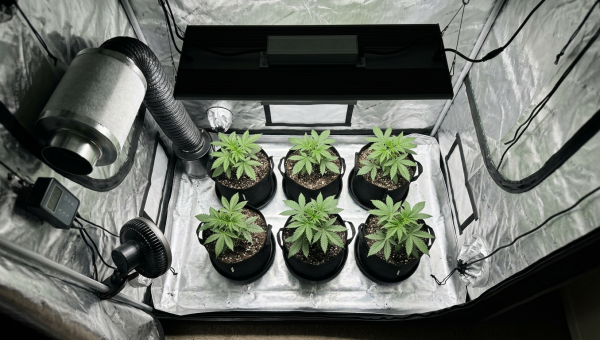
If you’ve ever stared at a half-empty grow tent and wondered why you’re waiting 90+ days for a handful of big plants to finish, the sea of green method might be the mindset shift you need. SOG flips the conventional wisdom on its head — instead of growing fewer, larger plants, you pack your space with smaller ones, push them into flower early, and harvest more often. The result is a canopy of uniform cola tops that your lights can actually reach, a faster turnaround per cycle, and — when done right — yields that beat what most single-plant grows can produce in the same footprint. I’ve been running SOG setups in Denver for years, and it’s one of the first techniques I recommend to growers who want to get more out of their space without spending more on equipment. This guide covers everything: plant counts, pot sizes, timing, strain selection, and the honest comparison between SOG and SCROG that most articles skip over.
- What the Sea of Green Method Actually Is (And Why It Works)
- SOG Setup by Tent Size: Real Numbers for Real Grows
- Ideal Pot Size and Root Zone Management
- Step-by-Step SOG Setup: From Seed (or Clone) to Canopy
- Environment Specs for a SOG Grow Room
- SOG vs. SCROG: An Honest Comparison
- Best Strains for Sea of Green: What Actually Works
- SOG with Autoflowers: A Different Game
- Common SOG Mistakes (And How to Avoid Them)
- Nutrients and Feeding Strategy for SOG
- Legal Considerations for SOG in the US
What the Sea of Green Method Actually Is (And Why It Works)
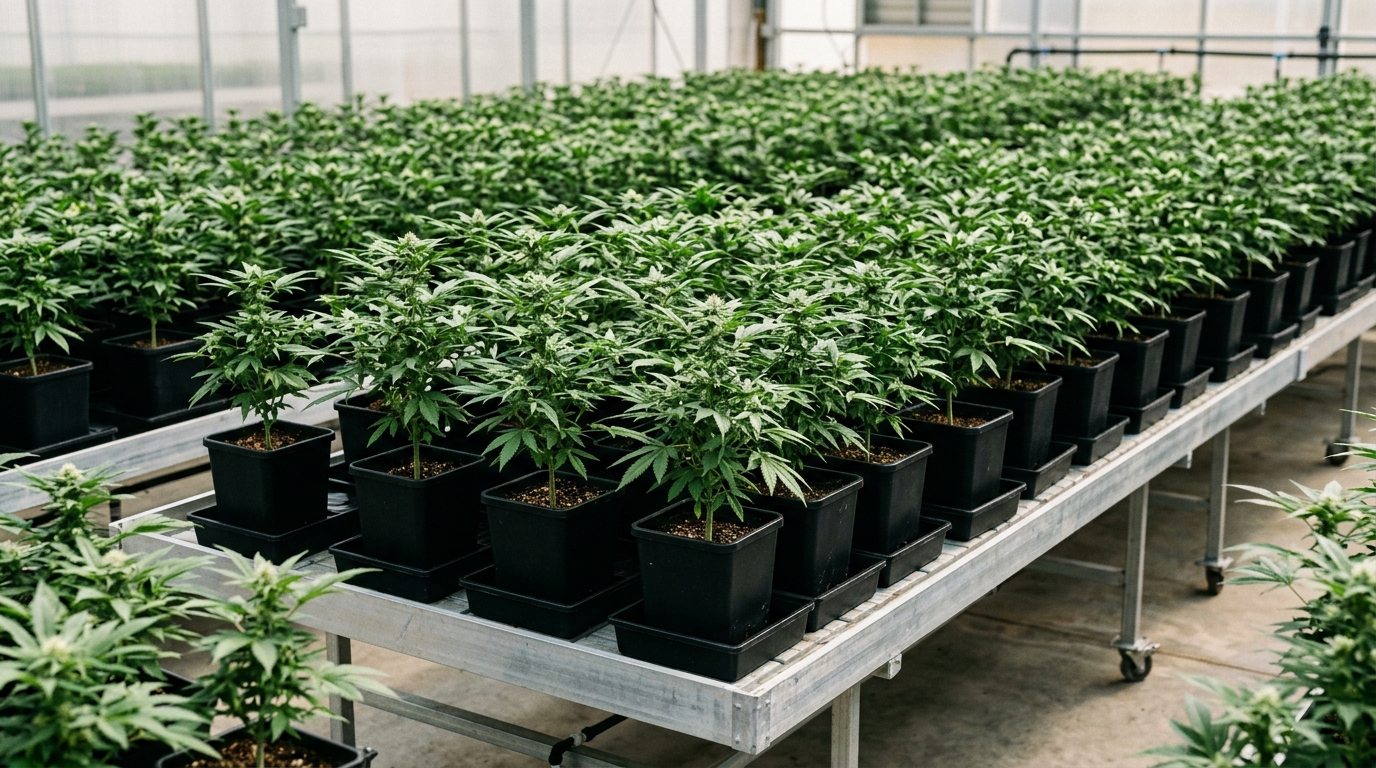
The sea of green method is built on one core principle: light efficiency. A single large cannabis plant develops one dominant main cola and a bunch of secondary sites that sit lower in the canopy, receiving less light intensity. Those lower buds are always going to be smaller and less potent than the top. SOG solves this by replacing that one plant with many smaller ones, each contributing a single primary cola that sits right at canopy level — all getting the same quality light at the same time.
The technique was pioneered in the Netherlands during the indoor growing boom of the 1980s and has remained a staple of commercial and home cultivation ever since. The logic is simple: rather than training one plant for weeks to fill a space, you fill that space with plants that are already the right size. You’re essentially outsourcing your canopy management to plant count instead of technique.
From a light physics standpoint, this matters enormously. Cannabis buds develop in direct proportion to the photosynthetically active radiation (PAR) they receive. When every plant in your room has its primary bud site sitting at the same height directly under your light, you’re maximizing the usable light footprint with almost no waste. That’s why SOG is particularly popular among growers using HPS or LED setups where light intensity drops off significantly below the canopy.
The time savings are just as compelling as the yield math. Because you’re keeping the vegetative phase short — sometimes as brief as one to two weeks after rooting — each cycle runs faster. More cycles per year means more total harvest weight annually, even if individual plant yield is lower. For growers in states like Colorado, California, or Michigan where plant count regulations apply, understanding this tradeoff is critical, and I’ll get into those legal considerations shortly.
SOG Setup by Tent Size: Real Numbers for Real Grows
One of the biggest gaps I see in most SOG guides is the lack of specific, actionable numbers for common grow spaces. Let me fix that. These figures are based on standard small-pot SOG practice, and they assume you’re using feminized photoperiod or autoflowering genetics in a well-dialed indoor environment.
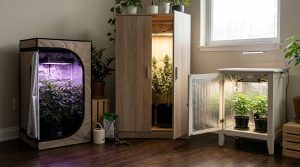
In a 2×2 tent (roughly 0.37 square meters), a practical SOG setup runs four to six plants in 1-gallon (approximately 3.8L) pots. You want enough space between pots for airflow — cramming in more plants than your air circulation can handle is a fast track to mold. With a solid LED or HPS fixture, a 2×2 SOG grow can realistically produce 2–3 ounces per cycle depending on genetics and environment. The real win here is running back-to-back cycles so your annual total climbs.
A 4×4 tent (roughly 1.5 square meters) is where SOG really starts to shine. You can comfortably run 16 plants in 1-gallon pots, or pull back to 9–12 plants in 2-gallon pots if you want slightly larger individual plants with a bit more root space. I’ve personally run 16-plant SOG setups in a 4×4 under a 600w HPS and pulled consistent results cycle after cycle. The canopy management is minimal because the plants are doing the work for you.
For larger spaces — a 4×8 or a dedicated 10×10 room — the math scales proportionally. The key constraint shifts from space to plant count regulations. In many US states, home growers are limited to six plants (as in Colorado, California, and Oregon for recreational grows), which fundamentally changes the SOG equation. If you’re in a state with a six-plant limit, SOG in the traditional sense becomes difficult to execute legally. Some growers work around this by using larger pots (3–5 gallons) and a modified SOG approach with light training, but that’s closer to a hybrid method. Always check your state’s current regulations before designing your setup — laws in states like Michigan, Nevada, and Illinois have specific plant count rules that directly impact SOG viability.
Our complete yield optimization guide digs into the broader hierarchy of techniques that work alongside SOG, including lighting upgrades and nutrient protocols that compound your results.
Ideal Pot Size and Root Zone Management
Pot size is where a lot of new SOG growers make their first mistake. The instinct is to go bigger — more root space, more plant, more yield. But in SOG, you’re deliberately constraining root development to keep plants small and push them through their cycle efficiently. The goal is a root-bound or near-root-bound plant that flowers aggressively because it senses the limits of its environment.
The sweet spot for most SOG grows is 1 to 2 gallons (approximately 3.8 to 7.5 liters). At 1 gallon, plants stay compact and finish fast, which is ideal for clone-based SOG where uniformity is paramount. At 2 gallons, you get a touch more root development and slightly larger individual plants — useful if you’re working with a lower plant count due to legal restrictions.
Going above 3 gallons in a true SOG defeats much of the purpose. Larger pots mean longer veg time to fill them, larger plants that shade each other, and a longer overall cycle. I’ve seen growers use 5-gallon pots and call it SOG — technically it can work, but you’re really doing a modified method at that point, not a true sea of green.
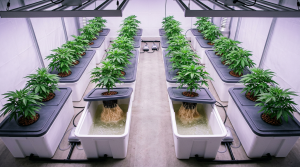
Hydroponics is exceptionally well-suited to SOG. Rockwool cubes, DWC buckets, and NFT systems all allow tight spacing while delivering nutrients directly to the root zone with high efficiency. Our hydroponic growing guide covers the specific system setups that pair best with high-density canopy methods like this one. Coco coir in small fabric pots is my personal go-to for SOG — it gives you the drainage and aeration of hydro with the simplicity of a soil-like medium, and the fabric pots air-prune the roots naturally, keeping plants from getting too leggy.
Step-by-Step SOG Setup: From Seed (or Clone) to Canopy
The most reliable SOG grows start from clones, not seeds. Here’s why: seed-grown plants have natural genetic variation. Even from the same packet, two plants can vary in height, stretch, and flowering time. When you’re trying to maintain a uniform canopy, that variation creates headaches — taller plants shade shorter ones, and you end up with an uneven light distribution that undermines the whole point of the method. Clones from a proven mother plant are genetically identical, so they grow at the same rate, hit the same height, and finish at the same time.
That said, if clones aren’t available to you — which is the reality for most home growers in states where dispensary clone sales aren’t common — you can absolutely run SOG from feminized seeds. Just pop more seeds than you need, cull any runts or outliers early in veg, and select your most uniform plants for the canopy. It adds a step, but it works.
Here’s how I build a SOG run from start to finish:
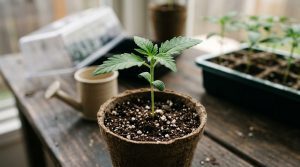
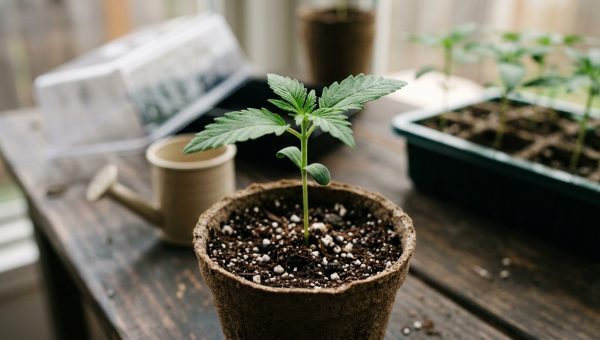
Step 1 — Propagation: Root your clones or germinate your seeds in small rockwool cubes or seedling plugs. Keep them under an 18/6 light schedule and maintain high humidity (70–80% RH) during this phase. Clones typically root in 7–14 days; seedlings need another week or two beyond that to be ready for transplant.
Step 2 — Short Vegetative Phase: Once rooted, transplant into your SOG pots and begin a brief veg phase. For clones, this can be as short as 7–14 days. For seedlings, I usually give 2–3 weeks. The goal is a plant that’s 6–12 inches tall with a single dominant apical shoot. You are NOT training, topping, or LST-ing these plants. SOG is a no-topping method by design — you want that single main cola.
Step 3 — Flip to Flower: Switch your lights to 12/12 to initiate flowering. At this point, your plants should be filling their allotted canopy space but not yet overlapping their neighbors. Expect a stretch of 50–100% during the first two weeks of flower — account for this in your final canopy height planning.
Step 4 — Lower Leaf Removal: About 2 weeks into flower, remove the lower 1/3 of each plant’s foliage. These lower branches receive minimal light and will only produce airy, underdeveloped buds. Removing them redirects the plant’s energy to the main cola and improves airflow through the dense canopy — critical for preventing mold and mildew in a tightly packed SOG setup.
Step 5 — Canopy Maintenance: Keep an eye on any plants that are stretching above the canopy line. Light defoliation of large fan leaves that are blocking light to neighboring plants is fine, but avoid heavy defoliation — you still need those leaves for photosynthesis.
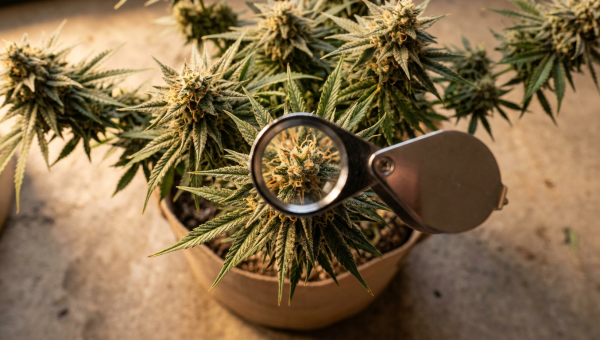
Step 6 — Harvest: Most SOG runs with indica-dominant or hybrid genetics finish in 7–9 weeks of flower. Harvest timing is best determined by trichome inspection — our cannabis harvest timing guide walks through exactly what to look for under a loupe or scope.
Environment Specs for a SOG Grow Room
Running a dense canopy creates a unique microclimate inside your grow space. More plant mass means more transpiration, higher humidity, and reduced airflow between stems. Getting your environment dialed is arguably more important in SOG than in any other training method — the cost of getting it wrong is magnified when you have 16 plants packed into a 4×4.
70–80°F (Prop/Veg) | 75–82°F (Early Flower) | 70–78°F (Late Flower)
65–70°F (Prop/Veg) | 68–75°F (Early Flower) | 65–72°F (Late Flower)
70–80% RH (Prop) | 55–65% RH (Veg) | 50–60% RH (Early Flower) | 45–55% RH (Late Flower)
0.8–1.2 kPa (Veg) | 1.2–1.8 kPa (Flower)
18/6 (Veg) | 12/12 (Flower)
6.0–7.0
5.5–6.5
The most critical environmental factor in a packed SOG canopy is VPD — vapor pressure deficit. VPD governs how efficiently your plants transpire and uptake nutrients. Too high and plants close their stomata, stalling growth. Too low and you’re creating conditions where mold and mildew thrive. Our complete VPD guide is worth bookmarking before you flip a SOG room to flower. Maya Chen has done a deep dive on how stomatal behavior under high-density conditions affects overall canopy health — the science directly supports why VPD management is non-negotiable in SOG grows.
Airflow deserves special attention. In a SOG setup, I always run at least one oscillating fan at canopy level plus one below the canopy pointing up through the stems. The goal is constant gentle movement of air through every layer of the grow. Stagnant air pockets in a dense canopy are where botrytis (bud rot) gets its start, and once it takes hold in a SOG grow, it can jump between plants fast.
SOG vs. SCROG: An Honest Comparison
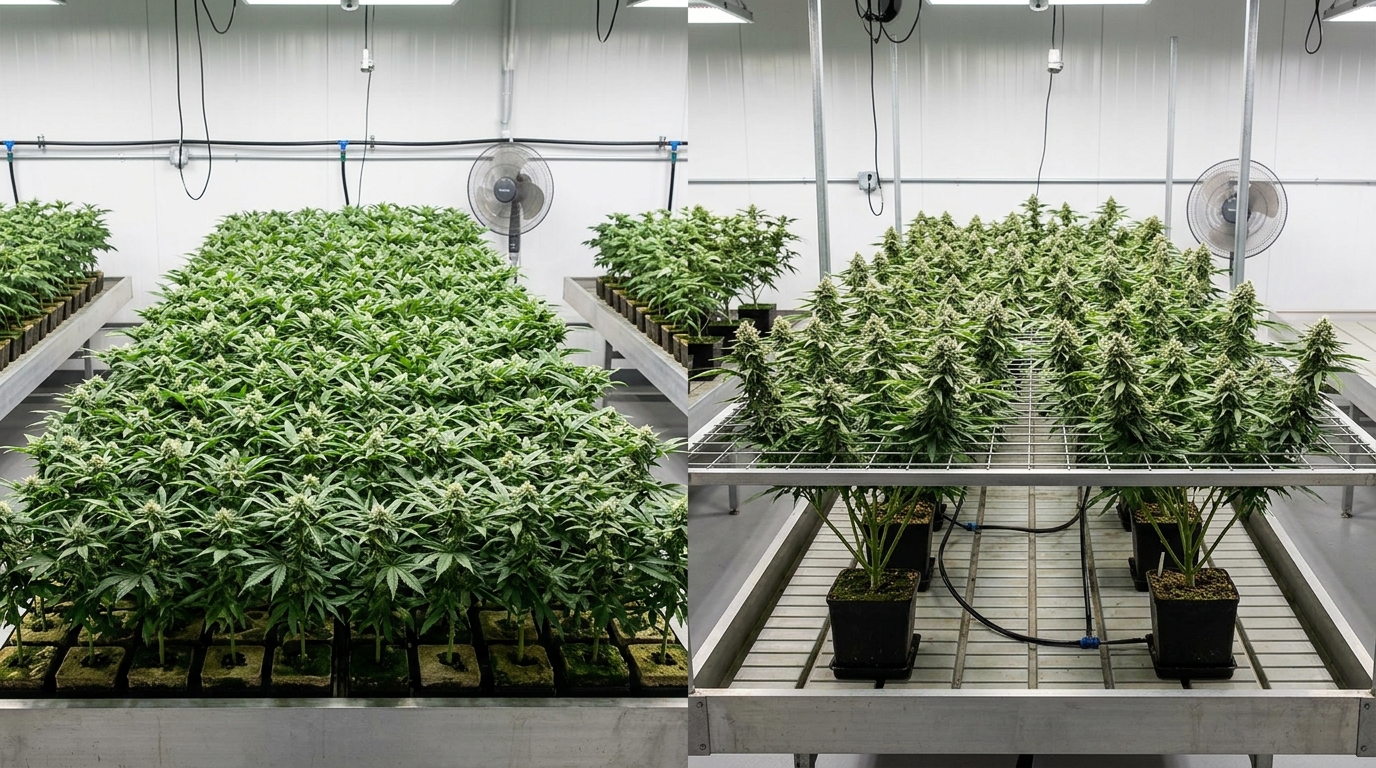
The SOG vs. SCROG debate comes up constantly in grow communities, and the honest answer is that neither method is universally better — they solve different problems for different growers. Let me break down what actually matters in this comparison.
SCROG (Screen of Green) uses a horizontal net or screen to train a smaller number of plants horizontally, weaving branches through the screen to create an even canopy. It’s a technique built for maximizing individual plant potential and is particularly effective with strains that have vigorous lateral branching. SOG, by contrast, doesn’t train plants at all — it uses plant count and early flowering to achieve canopy uniformity.
The key practical difference comes down to time investment and plant count. SCROG requires weeks of active training during veg — you’re constantly tucking branches under the screen, monitoring growth direction, and waiting for the screen to fill before you can flip. A typical SCROG veg phase runs 4–8 weeks. SOG veg can be as short as 1–2 weeks from clones. If you want faster turnaround, SOG wins on cycle speed.
On the other hand, SCROG is far more forgiving in jurisdictions with strict plant count limits. If you’re in Colorado or California where recreational home grows are capped at six plants, running a SCROG with four to six plants in large containers can produce impressive yields without pushing legal boundaries. SOG’s advantage disappears quickly if you can only legally run six plants.
| Factor | SOG (Sea of Green) | SCROG (Screen of Green) |
|---|---|---|
| Plant Count | High (9–16+ per m²) | Low (1–4 per m²) |
| Veg Time | 1–3 weeks | 4–8 weeks |
| Training Required | None (or minimal) | Active weekly training |
| Cycle Speed | Faster (shorter veg) | Slower (longer veg) |
| Ideal for Plant Count Limits | No — needs many plants | Yes — maximizes few plants |
| Clone Dependency | High — clones preferred | Low — works well from seed |
| Canopy Uniformity | High (from uniform clones) | High (from training) |
| Mold/Airflow Risk | Higher — dense canopy | Lower — open canopy |
| Best Genetics | Indica-dominant, compact | Sativa or hybrid, branchy |
| Beginner Friendly | Moderate | Moderate to difficult |
One thing both methods share: they reward growers who understand their environment deeply. Whether you’re running SOG or SCROG, dialed VPD, good airflow, and consistent lighting are what separate average results from exceptional ones. The indoor growing setup guide on our cannabis blog is a solid foundation for either approach.
Best Strains for Sea of Green: What Actually Works
Strain selection can make or break a SOG run. The ideal SOG strain has a few non-negotiable characteristics: compact structure, minimal lateral branching, a dominant central cola, short flowering time, and predictable stretch. Indica-dominant genetics check most of these boxes naturally, which is why they’ve been the backbone of SOG grows since the method was developed.
Northern Lights is probably the most iconic SOG strain in existence. It’s compact, consistent, finishes fast (around 7–8 weeks), and produces a dense, resinous main cola that thrives when given its own space under a light. I’ve run Northern Lights SOG probably a dozen times and it’s as reliable as it gets — the kind of strain that makes a new SOG grower feel like a pro.
Og Kush is another strong performer. It has more stretch than Northern Lights, so account for that when planning your canopy height, but the bud density and trichome coverage you get from an OG Kush SOG run is hard to beat. The terps on a properly finished OG Kush cola under direct light are something special.
White Widow has been a SOG staple for decades for good reason. It’s a robust hybrid that handles the stress of tight spacing well, finishes in about 8 weeks, and produces exceptional resin coverage. If you’re new to SOG and want a forgiving strain that rewards the method, White Widow is a great starting point.
Blue Dream is worth mentioning as a slightly more adventurous SOG option. It’s a sativa-dominant hybrid, which means more stretch and longer flowering time — typically 9–10 weeks — but the yield potential in a well-managed SOG canopy is substantial. Just be prepared to manage the height and give it a touch more space per plant than you would an indica.
For fast-finishing options, Green Crack delivers an energetic pheno with tight internodal spacing and a flowering time around 7–8 weeks. The Myrcene-dominant profile produces terps that really pop when the cola has had full light exposure throughout flower — exactly what SOG provides.
Girl Scout Cookies and its derivatives like Gelato perform well in SOG when you select compact phenos. These strains tend to have some phenotypic variation, so if you’re running from seed, pop extra and select your most uniform, compact plants before committing them to the SOG canopy.
What you want to avoid in SOG: tall, stretchy sativas with long flowering times (12+ weeks), heavily branching genetics that compete with neighboring plants, and any strain known for wide phenotypic variation when running from seed. Our 2026 strain guide breaks down growth characteristics across dozens of popular genetics if you want to dig deeper into strain selection.
SOG with Autoflowers: A Different Game
Autoflowering cannabis has changed the SOG calculus in interesting ways. Autos don’t rely on a light schedule change to flower — they transition based on age, typically beginning flower at 3–5 weeks regardless of photoperiod. This makes them inherently fast and compact, which sounds perfect for SOG on paper.
In practice, autos in SOG require a different mindset. Because you can’t control when they flower, you lose the ability to synchronize your canopy by holding plants in veg until they’re all the right size. Each plant flowers on its own timeline, which can create uneven canopy heights if your genetics aren’t consistent. This is why running autos in SOG works best with high-quality feminized auto seeds from reputable breeders where genetic consistency is tight.
The other key difference: autos don’t respond well to transplanting. The stress of a transplant during their brief veg phase can stunt growth and reduce final yield. For auto SOG, I always start seeds directly in their final container — no transplanting. A 1-gallon fabric pot is my preferred choice for auto SOG, giving enough root space for a healthy plant without encouraging excessive vegetative growth.
The spacing for auto SOG can be slightly more generous than photoperiod SOG — I typically run 4 plants per square foot rather than pushing to the maximum, because autos need good airflow and light penetration throughout their entire lifecycle since you can’t do a heavy lollipopping session without risking stress-related yield loss.
Travis Cole has explored autoflower performance in outdoor dense-planting scenarios that mirror many of the same principles as indoor SOG — his observations on auto phenotype consistency directly inform how I approach auto strain selection for tight-spacing grows. Understanding the genetics of autoflowering plants is also worth a read — our ruderalis explainer covers the genetic foundation that makes autos tick.
Common SOG Mistakes (And How to Avoid Them)
I’ve made most of these mistakes myself at some point, and I’ve watched newer growers repeat them. Here’s what actually trips people up in real SOG grows.
Skipping the lollipopping step. In a tight SOG canopy, the lower branches of each plant are essentially in permanent shade. They will never produce quality buds, but they will consume the plant’s energy and restrict airflow. Removing the bottom third of each plant about two weeks into flower is not optional — it’s a core part of the method. Skipping it leads to airy, underdeveloped lower buds and increased mold risk.
Overcrowding beyond what your ventilation can handle. More plants means more transpiration, which means more humidity. If your exhaust fan and circulation fans can’t keep up, you’re creating a mold incubator. The maximum plant count for your space isn’t determined by floor area alone — it’s determined by the capacity of your environmental controls. I always size up my exhaust fan when moving to SOG from a lower-density setup.
Using seeds with high phenotypic variation. Running regular or non-stabilized genetics in SOG is asking for trouble. Tall plants shading short ones, different stretch rates, different flowering times — it all compounds into a messy canopy that undermines the whole point of the method. Stick to feminized seeds from consistent breeders, or use clones. Our seed type comparison guide explains exactly why feminized seeds are the SOG grower’s default choice.
Flipping too early before roots are established. There’s a temptation to flip to 12/12 the moment clones are rooted to maximize speed. Resist it. Plants need at least a few days to a week in their final containers before flip to establish root contact with the medium. Flipping too early stresses plants and produces weak, slow initial flower development.
Neglecting pH in small containers. Small pots buffer pH poorly compared to large ones. A 1-gallon pot can swing pH significantly between waterings, especially in coco or hydro. Check your runoff pH every watering and dial it in — pH drift in small SOG containers is one of the most common causes of nutrient deficiencies that growers misdiagnose as something else. Our leaf diagnosis guide can help you identify what’s actually going wrong if your plants start showing symptoms.
Topping or heavy training. SOG is designed around the single-cola structure. Topping your SOG plants creates multiple bud sites that compete with each other and with neighboring plants. If you want to top and train, you’re moving toward SCROG territory — which is a valid choice, but it’s a different method with different timing requirements.
Nutrients and Feeding Strategy for SOG
Small containers in SOG mean your plants go through nutrients faster and have less buffer against overfeeding or underfeeding. The feeding strategy needs to match the container size and cycle speed.
During the brief veg phase, keep nitrogen levels moderate — you want healthy green growth but not the kind of lush, leafy vegetative explosion that creates airflow problems in a dense canopy. When you flip to flower, transition to a phosphorus and potassium-heavy bloom formula within the first two weeks. The faster cycle of SOG means you don’t have the luxury of a slow nutrient transition.
Watering frequency in 1-gallon pots is high — in coco or hydro, you may be feeding daily or even twice daily in peak flower. In soil, every 1–2 days is typical once the canopy fills out. The key metric is always moisture level at the root zone, not a fixed schedule. Lift your pots — if they feel light, it’s time to water.
Flushing before harvest is a topic of ongoing debate in the growing community, but in small SOG containers where nutrient buildup happens faster, I do run a 1-week plain water flush before harvest. Whether it affects final flavor is debatable, but it doesn’t hurt and gives me peace of mind.
Legal Considerations for SOG in the US
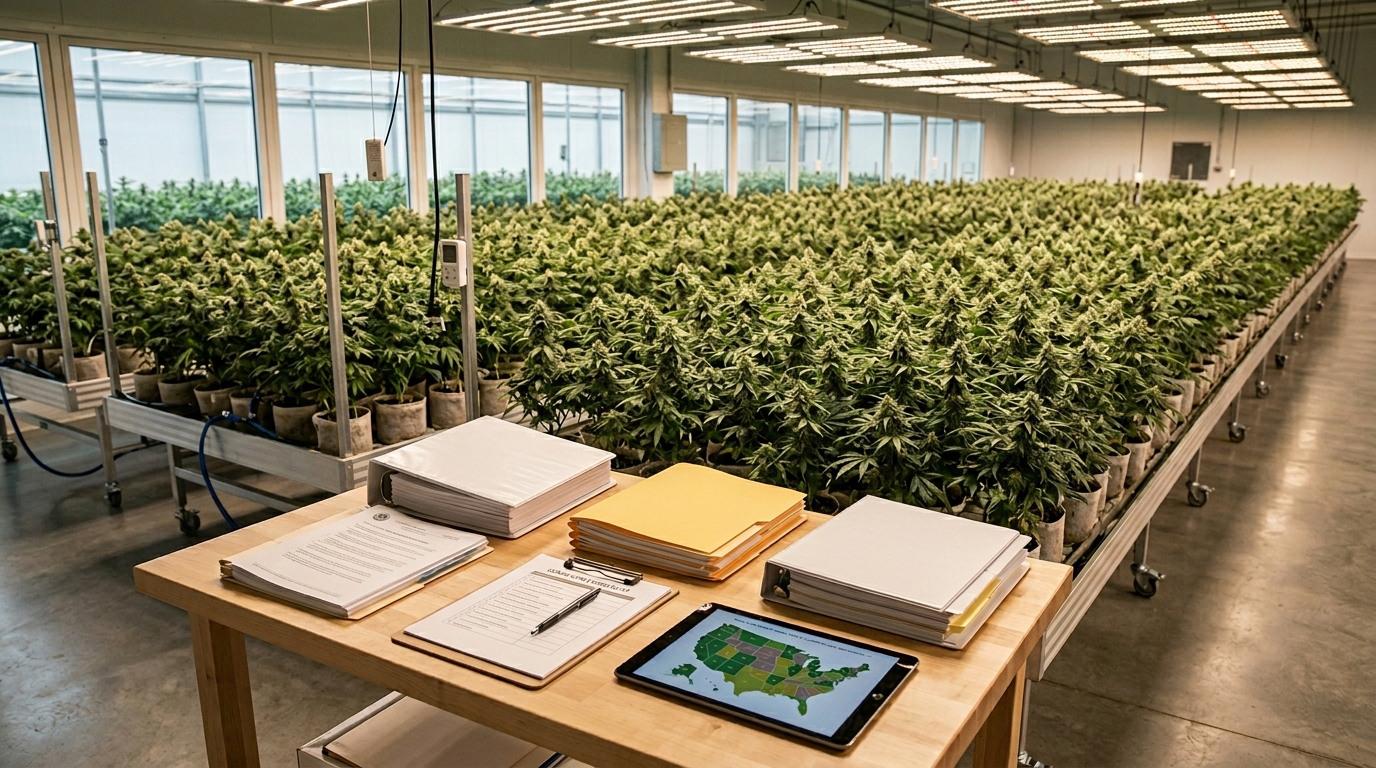
This is the section most SOG guides skip, and it’s arguably the most important one for home growers in the United States. The sea of green method’s effectiveness scales directly with plant count, which puts it in direct tension with most state-level home cultivation laws.
In Colorado (where I grow), recreational home cultivation allows up to six plants per person, with a household maximum of twelve plants. Running a true SOG at 16+ plants per 4×4 is not legal under personal cultivation rules. California has the same six-plant limit. Oregon allows four plants per household. Michigan allows twelve plants per household. Illinois allows five plants per person.
If you’re in a state with plant count restrictions, your SOG options are: use larger pots with fewer plants (modified SOG), focus on clone-based SOG within your legal limit, or consider a SCROG approach instead. Medical cultivation licenses in many states allow higher plant counts — if you’re a medical patient, check your state’s specific medical cultivation rules, as they often permit significantly more plants.
For growers in states where cannabis cultivation remains illegal, none of this applies legally — though we recognize that many people grow in those states and hope the legal landscape continues to evolve. If you’re just starting out and want to understand the full picture of growing cannabis legally, our complete home growing guide covers the legal landscape alongside the cultivation fundamentals.
Frequently Asked Questions: Sea of Green (SOG)
How many plants do I need for a sea of green?
The classic SOG recommendation is 9 to 16 plants per square meter (roughly 1 to 1.5 plants per square foot) in small 1 to 2-gallon containers. For a 4×4 tent (approximately 1.5 square meters), that translates to 12–16 plants. However, your legal plant count limit in your state should always be your first constraint — in most US states with six-plant recreational limits, true high-density SOG isn’t legally viable without a medical cultivation license.
What is the best pot size for sea of green?
The sweet spot is 1 to 2 gallons (3.8 to 7.5 liters) for most SOG setups. One-gallon pots keep plants compact and push fast cycling. Two-gallon pots give slightly more root development and work well when you’re running a lower plant count. Avoid going above 3 gallons in a true SOG — larger containers encourage more vegetative growth, longer cycle times, and plants that compete with their neighbors for canopy space.
Do you top plants in sea of green?
No — topping is not part of the traditional SOG method. SOG relies on the plant’s natural single apical cola structure. Topping creates multiple competing bud sites and slows the plant down, which defeats the purpose of the fast-cycling, single-cola SOG approach. If you want to top and train, you’re better suited to a SCROG setup where the training is built into the method.
Is SOG better than SCROG?
It depends entirely on your situation. SOG is better when you have access to many clones, want faster cycle turnaround, and have no plant count restrictions. SCROG is better when you’re limited to a few plants by law, prefer working with seeds, and are willing to invest more time in veg training for potentially larger individual plant yields. Many experienced growers have run both and choose based on the specific grow rather than a blanket preference.
Can you do sea of green with autoflowers?
Yes, but with modifications. Autoflowers are naturally compact and fast-finishing, which suits SOG in principle. The key differences: start seeds directly in their final container (no transplanting), use slightly more generous spacing than photoperiod SOG, and select genetics from breeders known for phenotypic consistency. Because autos flower on their own timeline rather than a light flip, canopy uniformity depends almost entirely on genetic consistency.
How long does a sea of green grow take?
From rooted clone to harvest, a well-executed SOG run with fast indica genetics takes approximately 8–10 weeks total: 1–2 weeks of veg plus 7–8 weeks of flower. From seed, add 2–3 weeks for germination and early seedling development, putting the total at 10–13 weeks. Compare this to a traditional single-plant grow that often runs 14–18 weeks from seed, and the time savings become clear — especially when you factor in running multiple SOG cycles per year.
What strains work best for sea of green?
Indica-dominant, compact strains with short flowering times (7–9 weeks) are ideal. Northern Lights, OG Kush, White Widow, and similar genetics have been SOG staples for decades. Look for strains described as having minimal lateral branching, a dominant central cola, and predictable stretch (typically 50–75% height increase from flip to finish). Avoid tall, branchy sativas with flowering times over 10 weeks unless you’re experienced with managing stretch in a dense canopy.