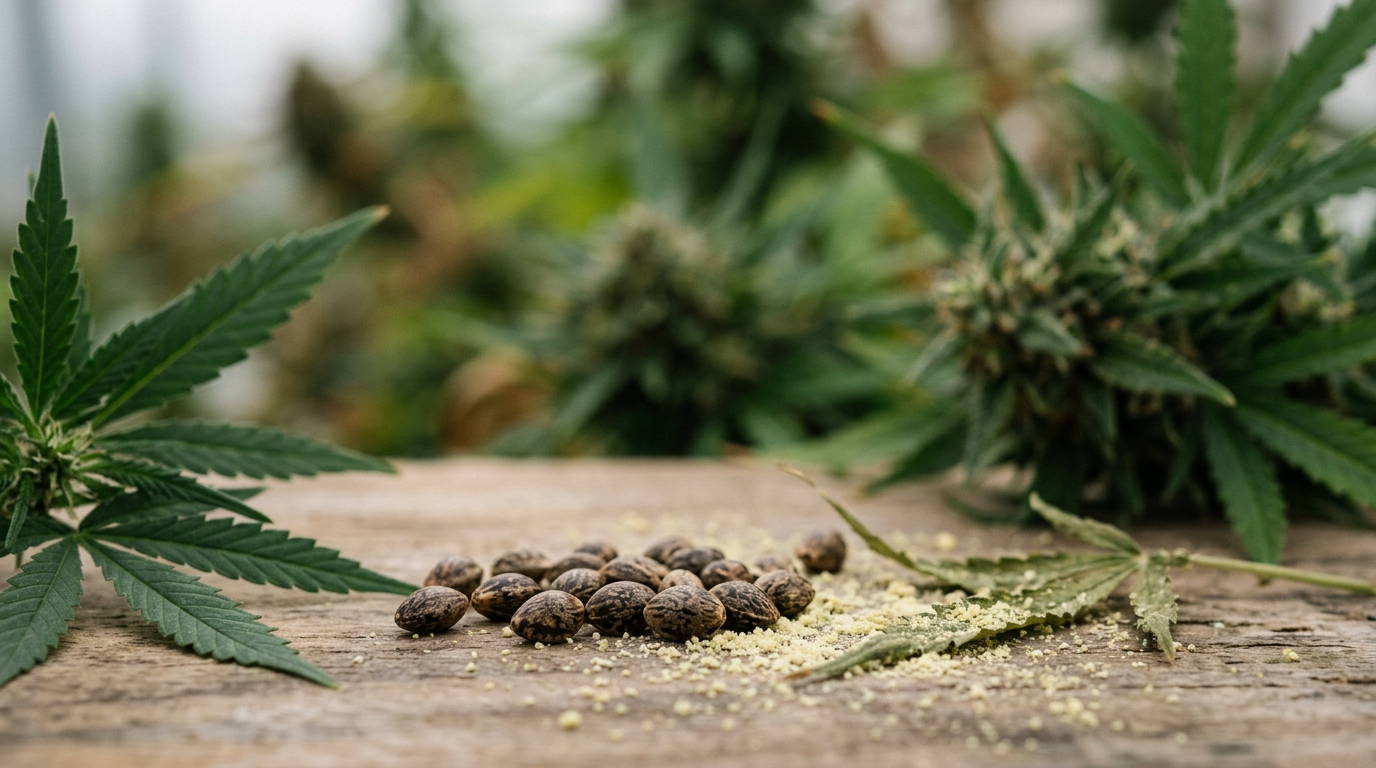
HHC (hexahydrocannabinol) is a hydrogenated cannabinoid that occurs naturally in trace amounts in cannabis pollen and seeds, and is commercially produced by converting CBD through a hydrogenation process. It produces psychoactive effects similar to Delta-9 THC, sits in a legal gray area under the 2018 Farm Bill, and may trigger positive results on standard drug tests.
Reviewed by Maya Chen, Cannabis Science Writer | Updated April 19, 2026
HHC has gone from obscure chemistry footnote to one of the most searched alternative cannabinoids on the market. I’ve spent considerable time analyzing the emerging research on this compound, and the science is both fascinating and genuinely incomplete. If you’re trying to understand what HHC actually is, how it compares to other cannabinoids, and whether it will show up on a drug test, this entry covers what the evidence actually supports.
What Is HHC? The Chemistry Behind the Compound
HHC is the hydrogenated form of THC, meaning hydrogen atoms have been added to THC’s molecular structure, saturating its double carbon bond. This structural change makes HHC more stable and resistant to oxidation and UV degradation than conventional THC. American chemist Roger Adams first synthesized HHC in 1944 by adding hydrogen to Delta-9 THC, making it one of the older semi-synthetic cannabinoids in the scientific record.
Commercially, HHC is not extracted from cannabis directly. The concentrations in natural plant material are far too low to be commercially viable. Instead, manufacturers typically start with CBD derived from hemp, convert it to Delta-8 or Delta-9 THC through isomerization, then apply a hydrogenation process using a metal catalyst such as palladium or nickel. The result is a mixture of two stereoisomers: 9R-HHC and 9S-HHC. This distinction matters enormously. Research published at PMC (Studies Pertaining to the Emerging Cannabinoid HHC) confirms that 9R-HHC binds effectively to cannabinoid receptors while 9S-HHC shows considerably weaker binding affinity. The ratio of these two isomers in any given product directly determines how potent that product actually is.
Commercial HHC products typically contain a 1:1 to 3:1 ratio of active to inactive isomers. That inconsistency is one of the more pressing concerns I have when evaluating HHC products from a consumer safety standpoint.
HHC Effects and How It Compares to Delta-8
Survey data from HHC users indicates the compound produces effects closely resembling Delta-9 THC, including euphoria, relaxation, altered sensory perception, and increased appetite. A survey study published on PubMed found that HHC users most commonly reported relaxation and euphoria, with a side effect profile including dry mouth, red eyes, and increased heart rate, all consistent with classical THC-like activity.
In my analysis of user-reported data, HHC sits somewhere between Delta-8 and Delta-9 THC in terms of intensity. Delta-8 produces a milder, clearer-headed experience. Delta-9 is the benchmark for full psychoactive potency. HHC lands closer to Delta-9 for most users, though the isomer ratio issue means this varies considerably from product to product.
Chemically, Delta-8 is an isomer of Delta-9 THC with a double bond at the 8th carbon position. HHC has no double bond at all in that chain. This gives HHC greater molecular stability and a longer shelf life than Delta-8, which degrades to CBN over time with light and heat exposure. Most users and the available survey data position HHC as somewhat more potent than Delta-8. If Delta-8 represents roughly 50-70% of Delta-9’s potency, HHC is generally placed closer to 70-80% of Delta-9’s effect. That said, a low-quality HHC product with a poor isomer ratio could easily underperform a well-produced Delta-8 product.
Did you know? According to the Oregon Liquor and Cannabis Commission, Oregon’s regulated cannabis market requires testing and labeling for all cannabinoid products sold through licensed dispensaries. HHC products sold outside that licensed framework, including many hemp-derived products sold online, are not subject to the same standards, meaning isomer ratios and contaminant levels are largely unverified by regulators.
Does HHC Show Up on a Drug Test?
This is the question I get asked most often about HHC. The honest answer: probably yes, and you should assume it will. The widespread claim that HHC doesn’t trigger standard drug tests is not supported by solid evidence.
Standard urine drug tests screen for THC-COOH, a metabolite produced when the body processes THC. HHC’s metabolic pathway appears to produce 11-hydroxy-HHC and similar metabolites that may cross-react with the antibodies used in immunoassay drug tests. Research detailed in HHC Pharmacology, Toxicology, and Analysis (PMC) confirms that HHC metabolites have been detected in urine samples and that standard immunoassay panels may flag HHC use as a positive result.
The claim that HHC evades drug tests originated partly from the argument that HHC’s hydrogenated structure produces different metabolites than Delta-9 THC. While technically true, “different metabolites” does not mean “undetectable metabolites.” Confirmatory GC-MS tests can specifically identify HHC metabolites. Anyone subject to workplace drug testing, probation requirements, or athletic drug testing should treat HHC exactly as they would any THC-containing product.
Safety, Production Quality, and Whole-Plant Alternatives
The safety profile of HHC is genuinely understudied. The compound has been commercially available in meaningful quantities only since roughly 2021, and the peer-reviewed safety data is correspondingly thin. Research suggests short-term effects mirror those of Delta-9 THC, including cognitive impairment, increased heart rate, and potential anxiety at higher doses. Long-term safety data simply does not exist yet.
The production process introduces additional concerns. Hydrogenation using metal catalysts can leave residual metals in the final product if manufacturing quality control is poor. A 2024 analysis on PubMed examining hexahydrocannabinols as recreational drugs flagged the lack of standardized production protocols as a meaningful public health concern. Without mandatory third-party testing, consumers have no reliable way to verify product purity.
If you’re interested in the cannabinoid experience and safety is a priority, growing your own cannabis from known genetics gives you far more control over what you’re actually consuming. The Terpenes and Trichomes of a well-grown plant represent a whole-plant chemistry that HHC isolates simply cannot replicate. That’s the entourage effect in action. For more context on how these compounds interact across the full Cannabinoids spectrum, the cannabis glossary covers each component in depth.
Key Facts
✓ HHC (hexahydrocannabinol) is the hydrogenated derivative of THC, first synthesized in 1944 by Roger Adams
✓ Commercially produced via hydrogenation of CBD-derived THC using metal catalysts such as palladium
✓ Exists as two stereoisomers: 9R-HHC (active) and 9S-HHC (less active); the ratio determines potency
✓ Effects are generally reported as similar to Delta-9 THC, and more potent than Delta-8 THC for most users
✓ HHC metabolites can be detected in urine and may trigger positive results on standard drug tests
✓ Sits in a federal legal gray area under the 2018 Farm Bill; state-level legality varies significantly
✓ Long-term safety data is currently unavailable; production quality and purity standards are inconsistent
✓ More oxidation-resistant than Delta-9 THC, giving HHC products a longer theoretical shelf life
Frequently Asked Questions
What kind of high does HHC give you?
Research suggests HHC produces a psychoactive experience closely resembling Delta-9 THC, including euphoria, relaxation, altered perception, and increased appetite. Survey data from HHC users consistently places its intensity above Delta-8 THC and approaching Delta-9 THC. Some users describe a slightly more clear-headed effect than Delta-9 at equivalent doses, but this is anecdotal and not yet confirmed by controlled clinical data. The actual experience also varies depending on the ratio of active 9R-HHC to inactive 9S-HHC in any given product.
Will HHC fail a drug test?
Almost certainly yes, at least on standard immunoassay urine tests. The popular claim that HHC evades drug tests is not supported by the available pharmacology research. HHC metabolites have been identified in urine samples, and standard THC immunoassay panels may cross-react with those metabolites. Confirmatory GC-MS testing can specifically detect HHC metabolites. Anyone facing employment drug screening, probation testing, or athletic testing should treat HHC exactly as they would Delta-9 THC.
Is HHC natural or synthetic?
HHC exists in nature in very small trace amounts within cannabis pollen and seeds, so it can technically be called a naturally occurring cannabinoid. However, the commercial quantities found in HHC products are entirely semi-synthetic, produced in a laboratory through hydrogenation of CBD-derived THC. The distinction matters for regulatory purposes: some argue that because HHC exists naturally in hemp, it qualifies as a legal hemp derivative under the 2018 Farm Bill. That legal argument remains contested and unresolved at the federal level.
Is HHC stronger than Delta-8?
For most users and based on available survey data, yes. HHC is generally reported as producing stronger psychoactive effects than Delta-8 THC, placing it closer to Delta-9 THC in potency. However, this comparison is complicated by the isomer ratio variable in HHC products. A poorly produced HHC product with a low 9R-HHC to 9S-HHC ratio could easily underperform a well-made Delta-8 product. Without standardized production and labeling requirements, potency comparisons across specific products are difficult to make reliably.
If HHC’s uncertain safety profile and inconsistent potency have you rethinking your cannabinoid options, whole-plant cannabis grown from verified genetics gives you full control over your experience. Explore our selection of high-THC seeds for a transparent, tested alternative.